Xiaojun
 2026-09-07
Salt Spray Test Hours vs. Real-World Lifespan: Don‘t Be Misled by “Hours to Red Rust”
One Common Myth
A buyer asks: “How many salt spray hours can your zinc-plated screws handle?”
The supplier answers: “72 hours, no red rust!”
The order is placed. But three months later, at a coastal construction site, the screws are already rusting.
What went wrong? Salt spray test hours do NOT directly translate to service life years.
What NSS Actually Measures
Neutral Salt Spray (NSS) per GB/T 10125 runs at 35°C with 5% sodium chloride solution, under continuous vertical fog. This is an accelerated lab test designed to compare coating performance under controlled conditions — not a simulator of any real-world environment. There is no simple conversion formula between salt spray hours and actual service life.
Matching Coatings to Environments
For indoor, dry applications such as office buildings or electronic devices, 24 hours of salt spray resistance is generally sufficient. For humid indoor environments like factory floors or pump rooms, 48 to 72 hours is recommended, typically achieved with yellow zinc plus a sealer. For general outdoor use in urban or light industrial areas, 120 to 240 hours is appropriate, which requires zinc-nickel alloy or Dacromet coating. For coastal outdoor projects such as seaside buildings and docks, the requirement jumps to at least 720 hours, demanding thicker zinc-nickel (12-15μm) or high-performance Dacromet. In the most severe conditions — offshore platforms or within 500 meters of the sea — 1000 hours or more is necessary, often requiring Dacromet with a topcoat or hot-dip galvanizing with a finish paint.
Beyond Just “Hours to Rust”
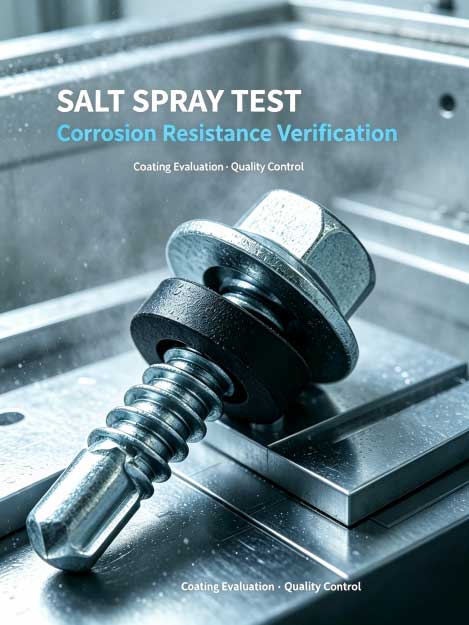
A truly professional evaluation never looks at a single number. We track three metrics. The first is time to first red rust — when corrosion begins on the base metal. The second is red rust area percentage at a given time point — for example, at 720 hours, the rusted area must remain under 5 percent of the total surface. The third is corrosion creepage width from scratches, measured at a cross-scratch line. For quality coatings, this lateral creepage should stay within 1.5 millimeters, because real installation almost always creates surface scratches, and the coating’s ability to resist spreading corrosion from those scratches determines its actual long-term performance.
Advanced Testing for Severe Conditions
For coastal or de-icing salt environments, standard NSS is insufficient by itself. Cyclic corrosion tests, such as the PV 1210 standard used in the automotive industry, alternate between salt spray, high-temperature drying, and condensing humidity to simulate day-night wet-dry cycles. These are far more representative of real field conditions. For critical applications, we also offer CASS testing (copper-accelerated acetic acid salt spray), which corrodes at roughly three to five times the rate of NSS and better mimics high-chloride coastal atmospheres.
Our Commitment
We do not promise “the highest possible salt spray hours” — that statement is meaningless without context. Instead, we start by analyzing your actual service environment and calculate a reasonable salt spray requirement. We then provide complete test reports with every batch, documenting hours to first rust, rust area percentage, and corrosion creepage width. For key projects, we offer CASS or cyclic corrosion testing upon request. We also retain sealed samples from every batch for future traceability and verification.
Salt spray reports are health checks — not lifetime guarantees. The real question is whether you know the environment your screws will face, and whether your coating is engineered to match it.
Tell us your working conditions. We will deliver the right coating for them.
© 2026 Handan Xiaojun Fastener Manufacturing Co.,Ltd





 2026-09-21
 Xiaojun Catalogue 2025